
Reverse Mortgage Equity Projection
Lifetime Equity Projection
By definition, amortizing a loan is the act of paying it down in installments. Most standard mortgages amortize over a 30-year period, requiring regular payments.
Reverse Mortgages do not require regular monthly payments. This means that they do not amortize unless the borrower elects to make optional payments that include a reduction of the loan principal.
Some homeowners intentionally use a Reverse Mortgage this way because they want the flexibility of making payments when it makes sense for them, while still enjoying the freedom that a Reverse Mortgage provides.
For more information on this please go to our page in the General Information section titled “Ultimate Flex-Pay Mortgage”
Since Reverse Mortgage balances can increase over time, many of the seniors we speak with are concerned that it is going to deplete all the equity in their home, leaving nothing for their heirs. In reality, with today’s Reverse Mortgage products, that outcome is generally unlikely.
One of the most important safeguards that was added to these products was a significant reduction in the amount of home equity seniors are permitted to access. While this change means that fewer seniors qualify for these loans, it also provides much greater equity protection for those who do. As a result, a home's value will often appreciate at a faster rate than the Reverse Mortgage balance grows, even if the homeowner chooses to defer all monthly mortgage payments.
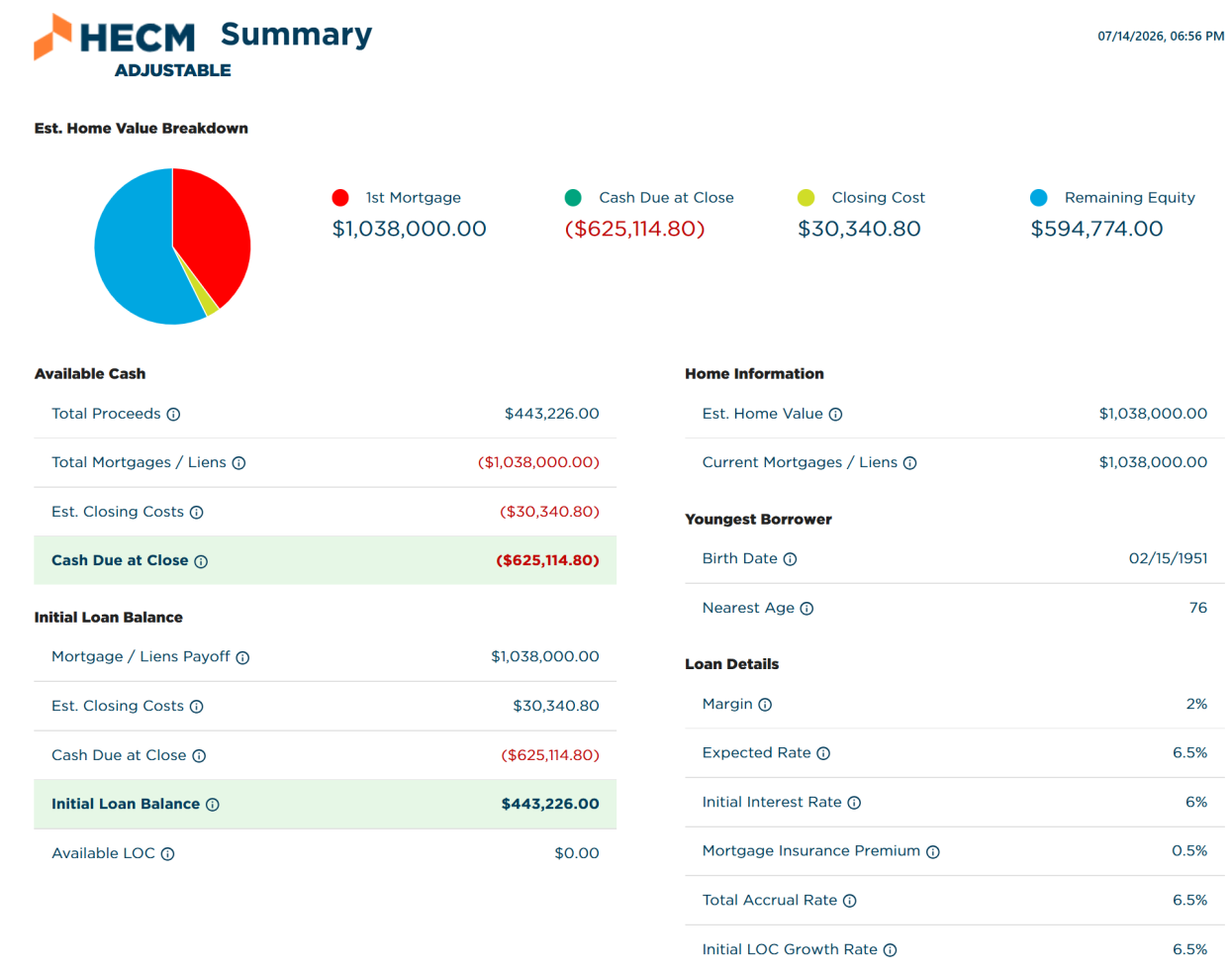
Below is an example of a future equity projection for a client we recently assisted. This was for a purchase, but the numbers would be the same for a refinance.
Please note that this is only an example based on one client's circumstances. Actual results will vary depending on factors such as the age of the borrower(s), the home's value, the Reverse Mortgage product selected, interest rates, and other individual considerations.
If you would like to see what a future equity projection might look like based on your own circumstances, we would be happy to prepare a personalized analysis for you.
This client was 75 years old. She was purchasing a house for $1,038,000 and putting down $625,114 from the sale of her departing residence. When she purchased the new house, she had $625,114 in equity. If her home appreciates just 4% per year for the next 20 years, the value will be $2,274,385.
If she makes no payment at all on the Reverse Mortgage balance and allows the interest to accumulate, that loan balance would be $1,620,617 (assuming that the interest rate remains the same for the life of the loan). This means that after 20 years of living in her home with no monthly mortgage payments, her equity in the house would have actually increased from $625,114 to $653,768. Below is the breakdown of the numbers in her example:
HOME EQUITY CONVERSION MORTGAGE (HECM)
Projected Loan Balance and Equity Example
Age: 75 Years | Purchase Price: $1,038,000 | Loan Amount: $443,226 | Cash to Close: $625,114
LOAN BALANCE/ HOME VALUE SCHEDULE – Assuming the interest rate remains at 6% for the duration of the loan. A reduction in the rate would result in lower increases to the loan balance, and an increase in the rate would result in a higher increase in the loan balance.
| Over 20 years (based on $0 monthly payment) | ||||||
|---|---|---|---|---|---|---|
| Year End | Age | Home Appreciation | Monthly Payment | Home Value Year End | Loan Balance | Net Equity Year End |
| 1 | 77 | 4% | $0 | $1,079,520 | $472,910 | $606,610 |
| 5 | 81 | 4% | $0 | $1,262,886 | $612,897 | $649,989 |
| 10 | 86 | 4% | $0 | $1,536,493 | $847,522 | $688,971 |
| 15 | 91 | 4% | $0 | $1,869,379 | $1,171,969 | $697,410 |
| 20 | 96 | 4% | $0 | $2,274,385 | $1,620,617 6 | $653,768 |
Lifetime Model
Visualize key details of the Reverse Mortgage over time
Home Value Year Start : $1,038,000.00
Loan Balance Year Start : $443,226.00